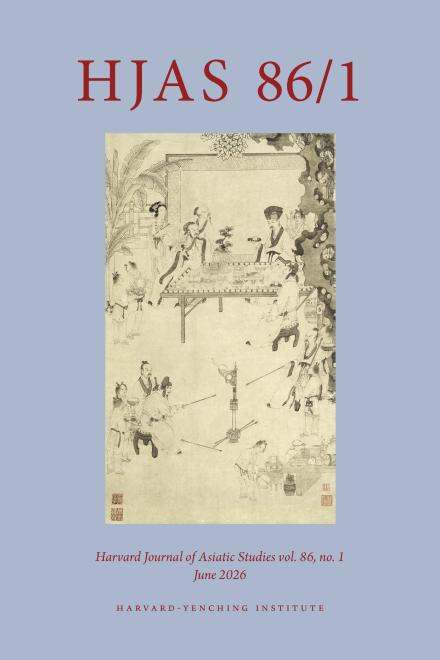
The detail of a hanging scroll reproduced on the cover of this issue of HJAS is from a painting by the late Ming dynasty (1368–1644) artist You Qiu 尤裘 (or 尤求; ca. 1540–1590), the full view of which is provided on the facing page. Unfortunately, little is known about You Qiu’s life, and he remains a particularly elusive figure who left few historical traces. The little we do know suggests he was likely the son-in-law of the enigmatic and often imitated Qiu Ying 仇英 (1494–1552), a celebrated painter associated with both the Suzhou-based Wumen school (Wumen huapai 吳門畫派), known for their restrained yet refined and precise plain line (baimiao 白描) brushwork, and the Zhe school (Zhe pai 浙派), known for their narrative figure painting.1 The Harvard Art Museums catalogue provides two unrelated titles for the painting, one in English and the other in Chinese. The English title is “A Gathering of Scholars in a Garden,” which seems appropriate for a scene depicting a group of seven elite males, one female attendant, and eight boy attendants in a courtyard amidst a towering porous Taihu rock (Taihu shi 太湖石)—a staple of Chinese garden design—a large Chinese parasol tree (wutong 梧桐) on the right, and a smaller banana tree on the left. The three gentlemen in the back appear to be enjoying a convivial gathering, with a variety of drinks and snacks arrayed on a table. The scene in the foreground (the lower part of the painting), which appears to be the main subject of the piece, must have inspired the Chinese title Touhu tu 投壺圖, referring to the game of “pitch pot” (touhu 投壺) that is taking place between two seated male figures.2
Pitch pot is attested in ancient China, but its precise origins are unclear. The game may have been invented by soldiers who began pitching arrows into an empty wine vessel to cultivate their skills or alleviate boredom. Whatever its origins, pitch pot became a drinking game enjoyed in aristocratic circles. One of the earliest—and most detailed—mentions of pitch pot is in the Liji 禮記 (Book of rites), a collection of entries on classic ritual practice and theory compiled between the Warring States period (475–221 BCE) and Han dynasty (202 BCE–220 CE).3 The Liji dedicates a separate entry to pitch pot, describing it as a highly ritualized game that tests the skills of the participants. Two players, a host and a guest, take turns attempting to throw a set of four headless arrows into the narrow tubular neck of a distant vase or, in some cases, into the secondary openings on the sides, like those depicted in You Qiu’s painting.4 Whoever succeeds in landing the most arrows in the vessel’s openings is declared the winner, and they proceed to offer the loser a drink. The description in the Liji says:
(The host) having bowed, and received the arrows (for himself), advances to the space between the two pillars. He then retires and returns to his station, motioning also to the guest to go to his mat (for pitching from). The superintendent of the archery comes forward and measures the distance of the pot (from the mats), which should be a space of the length of two and a half arrows. He then returns to his station, sets forth the stand for the tallies, and with his face to the east, takes eight counters and stands up. He asks the guest to pitch, saying, “When the arrow goes straight in, it is reckoned an entry. If you throw a second (without waiting for your opponent to pitch), it is not reckoned.” The victor gives the vanquished a cup to drink… . He then orders the cups to be filled, saying, “Let the cup go round,” and the cupbearer (of the successful side) replies, “Yes.” Those who have to drink all kneel, and raising their cups with both hands, say, “We receive what you give us to drink.” The victors (also) kneel and say, “We beg respectfully to refresh you.”5
Despite pitch pot being a drinking game (or perhaps because of it), there is also an emphasis on ritual propriety and the comportment of the players: “In Lu 魯, the young people (taking part in the game) were admonished in these words, ‘Do not be rude; do not be haughty; do not stand awry; do not talk about irrelevant matters; for those who stand awry, or speak about irrelevant matters, there is the regular (penal) cap.’”6
The Liji’s description of a pitch-pot gathering also suggests that it was a form of entertainment that took place in a sonic environment punctuated by music—a scene that might provide some sense of the gatherings described in Matthew Wild’s article in this issue, “Learning to Hear: Evidential Scholarship and the Ancient Song in High Qing China.” According to the Liji, the host is supposed to ask the musician, or “player of a stringed instrument” (xianzhe 弦者), to perform the song “Fox head” (“Lishou” 狸首) in an even tempo.7 The musical accompaniment to the pitch-pot game is depicted in the Liji with cryptic notations that include numerous small circles and squares.8 The circles seem to indicate blows to be struck on a small drum, and the squares indicate blows on the larger drum that are timed to particular junctures in the game. The pitch pot entry in the Liji ends with information about the attendants and their division of labor, which also brings to mind the discussion of servile laborers in Tina Lu’s article in this issue, “Slavery and Zhang Dai’s Aesthetics.” The Liji explains that “the superintendent of the archery, the overseer of the courtyard, and the capped officers who stood by all belonged to the party of the guest. The musicians and the boys who acted as attendants, all belonged to the party of the host.”9
Pitch pot appears in a variety of other early texts, including the Zuo Tradition (Zuozhuan 左傳; ca. fourth century BCE), which records how the game became an implicit competition for hegemony between rival rulers in an event dated 530 BCE.10 In Records of the Grand Historian (Shiji 史記; second–first century BCE) and History of the Later Han (Hou Hanshu 後漢書; 445 CE), pitch pot marks conviviality and refined entertainment.11 One early tale (ca. third century) connects the game to the origins of lightning: the Lord of the East (Dong Wanggong 東王公) and the Jade Maiden (Yunü 玉女) are playing pitch pot in heaven.12 Heaven laughs at the former’s mistakes, and light streams from its open mouth to become lightning. In general, most accounts of pitch-pot games mention lively gatherings replete with refined music, good wine, and abundant food. We also read about notable figures who enjoyed playing pitch pot in other sources. For instance, Wang Bi 王弼 (226–249 CE), the famed commentator of the Daodejing 道德經, is said to be someone who was “rational and amiable, and enjoyed outings and feasts. He was good at music and pitch pot.”13 Pitch pot continued to be enjoyed by aristocrats and officials through the Tang and Song dynasties, with many texts entitled the Classic of Pitch Pot (Touhu jing 投壺經) listed in bibliographic catalogues, and it spread to Korea (tuho 투호) and Japan (tōko とうこ), where it became an aristocratic leisure-time activity and remains a popular folk game down to the present day.
Although pitch pot is referred to in medieval texts as a pastime enjoyed at aristocratic gatherings, it was only in the Ming dynasty that it became a more widespread game also played by wealthy merchants, scholars, and others—a token of the continuing changes in elite cultural practices foreshadowed by Ya-hwei Hsu’s article in this issue of HJAS. It is perhaps not surprising, therefore, to find that pitch pot is featured in fictional episodes of drinking and merriment in the late sixteenth century Plum in the Golden Vase (Jinpingmei 金瓶梅).14 In that novel, pitch pot is described in a way that resonates with its image as depicted in the painting on the cover of this issue: “‘Let’s get some wine,’ said Ximen Qing 西門慶, ‘and have a game of pitch pot here under the Taihu rockery, just for the fun of it. Come, share three cups with me.’”15 Later, the description of the scene continues:
It so happened that when the two of them arrived underneath the grape arbor, they found that four cool porcelain taborets [mobile storage cabinets] had been placed there with a bronze vessel for the game of pitch-pot to one side. Jinlian 金蓮 leaned the moon guitar against one of the taborets and started to play pitch-pot with Ximen Qing. At this juncture, what should they see in the distance but Chunmei 春梅 bringing the wine and Qiuju 秋菊 toting a box of delicacies, with a bowl of iced fruit on top of it.16
The resemblance between this episode from Plum in the Golden Vase and the cover image is striking, with both harkening back to the ancient version of the ritual depicted in the Liji. That the novel and the painting were both a product of the late sixteenth century accords well with what we know about the history of the ancient pitch-pot ritual game, which was revived and became popular as a form of entertainment at around the same time in the Ming dynasty. Much as Matthew Wild’s article shows that evidentiary rediscoveries of ancient knowledge suffused elite social networking and fueled poetic creativity in the Qing, You Qiu’s painting represents another example of antiquarian interest that could cement literati relationships and inspire artistic expression in late imperial China. Finally, given the critical reading strategy discussed in Tina Lu’s article, it is noteworthy that in the literary representations and the visual depiction of the painting, the pampered elites playing pitch pot are outnumbered by the attendants providing the type of labor necessary for them to enjoy their elegant garden gathering.
Footnotes:
- On Qiu Ying, see Stephen Little, Where the Truth Lies: The Art of Qiu Ying (Los Angeles: Los Angeles County Museum of Art, 2020); and Ellen Johnston Laing, “Qiu Ying’s Delicate Style,” Ars Orientalis 27 (1997): 39–66.
- For general descriptions of pitch pot, see Gösta Montell, “T’ou Hu: The Ancient Chinese Pitch-Pot Game,” Ethnos 5.1–2 (1940): 70–83; and Richard Casper Rudolph, “The Antiquity of T’ou Hu,” Antiquity 24 (1950): 175–78. See also Isabelle Lee, “Touhu: Three Millennia of the Chinese Arrow Vase and the Game of Pitch-Pot,” Transactions of the Oriental Ceramic Society 56 (1991–1992): 13–27.
- “Touhu,” Liji jijie 禮記集解, comp. Sun Xidan 孫希旦 and ed. Shen Xiaohuan 沈嘯 寰 and Wang Xingxian 王星賢, 61 juan 卷 in 3 vols. (Beijing: Zhonghua shuju, 1989), v. 3, j. 56, pp. 1383–97.
- There are also surviving ceramic and bronze vessels that appear to be like those used in actual pitch-pot games. See, for example, Rong Geng 容庚, Shang Zhou yiqi tongkao 商周彝器通考, 2 vols. (Beijing: Harvard-Yenching Institute, 1941), v. 2, nos. 704–83; and Charles Fabien Kelly and Ch’en Meng-chia, Chinese Bronzes from the Buckingham Collection (Chicago: Art Institute of Chicago, 1946), p. 127, plate 75. This evidence is discussed briefly in Rudolph, “Antiquity of T’ou Hu,” which compares the vessels to visual images of the game.
- James Legge, trans., The Sacred Books of China: The Texts of Confucianism, pt. 4: The Lî Kî, 2 vols. (Oxford: Clarendon Press, 1885), v. 2, p. 398; see also Liji jijie, v. 3, j. 56, pp. 1386–91.
- Legge, Lî Kî, v. 2, p. 400; Liji jijie, v. 3, j. 56, pp. 1395–96.
- The received text of the Shijing 詩經 (Book of odes) does not include “Lishou,” but it may have been one of the “lost odes” (yishi 逸詩). It is also mentioned in connection with archery in another chapter in the Liji; see “Sheyi” 射義, Liji jijie, v. 3, j. 60, p. 1439.
- Liji jijie, v. 3, j. 56, p. 1396; Legge, Lî Kî, v. 2, pp. 400–401. The original text of the Liji has: 鼓○□○○□□○□○○□半○□○□○○○□□○□○魯鼓○□○○○□□○□○○□□○□○○□□○半○□○○○□□○薛鼓取半以下為投壺禮盡用之為射禮.
- Legge, Lî Kî, v. 2, p. 400; Liji jijie, v. 3, j. 56, p. 1397.
- See Zuo Tradition/Zuozhuan: Commentary on the “Spring and Autumn Annals,” trans. Stephen Durrant, Wai-yee Li, and David Schaberg, 3 vols. (Seattle: University of Washington Press, 2016), v. 3, Zhao 昭 12.4, pp. 1472–75.
- See Sima Qian 司馬遷, “Huaji lie zhuan” 滑稽列傳, Shiji, 130 juan in 10 vols. (Beijing: Zhonghua shuju, 1982), v. 10, j. 126, p. 3199; “Yao Qi Wang Ba Zhai Zun liezhuan” 銚期王霸祭遵列傳, in Hou Hanshu, comp. Fan Ye 范曄 and annot. Li Xian 李 賢, 120 juan in 12 vols. (Beijing: Zhonghua shuju, 1965), v. 2, j. 20, p. 742.
- See Shenyi jing 神異經 (ca. first–second century CE), in Han Wei Liuchao biji xiaoshuo daguan 漢魏六朝筆記小說大觀, ed. Wang Genlin 王根林 et al. (Shanghai: Shanghai guji chubanshe, 1999), p. 49.
- This description comes from He Shao’s 何劭 biography of Wang Bi that was appended to the twenty-eighth chapter of the Weishu 魏書 portion of Sanguo zhi 三國志, comp. Chen Shou 陳壽 and annot. Pei Songzhi 裴松之, 65 juan in 5 vols. (Beijing: Zhonghua shuju, 1959), v. 3, j. 28, pp. 795–96. My translation is based, with some minor changes, on that of Paul J. Lin, A Translation of Lao Tzu’s Tao Te Ching and Wang Pi’s Commentary (Ann Arbor: Center for Chinese Studies, University of Michigan, 1977), p. 151.
- See Tokuda Takeshi 徳田武, “Tōko to Kinpeibai” 投壺と『金瓶梅』, Edo fūga 江戸風雅 24 (2021): 3–44.
- Lanling Xiaoxiaosheng 兰陵笑笑生, Jinpingmei cihua 金瓶梅词话, annot. Tao Muning 陶慕宁 and ed. Ning Zongyi 宁宗一, 2 vols. (Beijing: Renmin wenxue chubanshe, 2000), v. 1, p. 347. The translation, with romanizations converted to pinyin, is from David Tod Roy, trans., The Plum in the Golden Vase or, Chin P’ing Mei, vol. 2: The Rivals (Princeton, NJ: Princeton University Press, 2001), p. 140.
- Roy, Plum in the Golden Vase, v. 2, p. 143; Lanling Xiaoxiaosheng, Jinpingmei cihua, v. 1, pp. 348–49.